


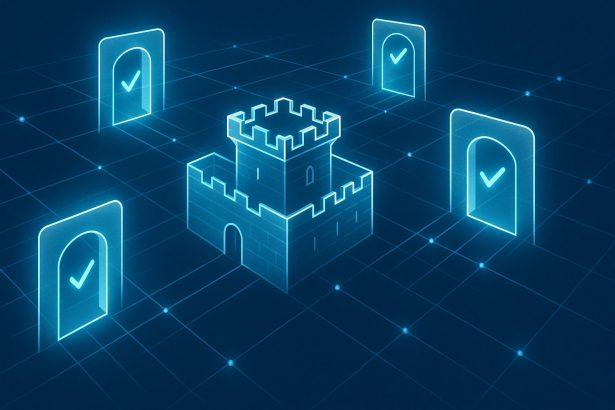
Breaches That Broke the Castle
When ransomware hit a midsize hospital’s scheduling system last spring, clinicians reverted to pen and paper. The attackers hadn’t leveraged exotic malware—they used a reused login credential, moving laterally across the network until core systems were locked. Such incidents are common in healthcare, where stolen credentials fuel ransomware campaigns and overwhelm thinly resourced IT teams (Wired).
That hospital wasn’t the only target. In May 2021, a ransomware attack forced Colonial Pipeline, which supplies nearly half the fuel consumed on the U.S. East Coast, to shut down operations. Attackers had gained access using a compromised VPN account that lacked multifactor authentication (Wikipedia). The disruption triggered fuel shortages, panic buying, and federal emergency measures.
Earlier, in December 2020, the SolarWinds supply-chain breach undermined trust in widely used software. Malicious updates—believed to have been orchestrated by a nation-state group—were distributed under the guise of legitimate patches, granting attackers access to U.S. government agencies for months before detection (CISA).
These incidents share a critical lesson: attackers rarely need to storm the digital perimeter. Once inside, everything behind the wall is treated as trusted, making breach escalation both swift and devastating.
The Old Model and Why It Failed
For much of the internet’s history, security thinking revolved around the castle-and-moat metaphor. Build tall walls—firewalls, intrusion prevention systems, antivirus software—and you could keep the enemy out. Inside the walls, trusted users and machines roamed freely.
The Rise of Perimeter Defenses
In the 1990s and early 2000s, this model made sense. Most corporate systems lived in on-premises data centers. Employees sat at desks inside office networks. The “edge” was a definable border, usually a set of IP ranges controlled by the organization.
Firewalls filtered traffic. VPNs created encrypted tunnels for traveling staff. Antivirus suites guarded against known threats. The security industry marketed these as impenetrable defenses, and for a time, they worked.
But cracks began to show.
- Worms like Code Red and Slammer spread rapidly across corporate networks in the early 2000s, exploiting unpatched machines once they made it inside.
- Target’s 2013 breach, in which attackers entered via a third-party HVAC vendor and moved laterally to point-of-sale systems, showed how porous “trusted” zones could be.
- Edward Snowden’s 2013 disclosures highlighted insider risk: once a user had privileged access, perimeter defenses did little to stop data exfiltration.
The implicit assumption—that threats came from outside—was no longer true.
The VPN Bottleneck
Virtual private networks, long seen as a security staple, became a glaring weakness. By 2020, as the COVID-19 pandemic sent entire workforces home, VPN servers were overwhelmed. Employees funneled all traffic through them, creating performance bottlenecks and, worse, single points of failure.
Attackers noticed. According to the FBI, VPN vulnerabilities became one of the most exploited categories in 2020–2021, with attackers leveraging them as stepping stones into corporate environments (FBI).
The VPN, once a trusted bridge, was increasingly a liability.
Cybersecurity for Business
Your business faces constantly evolving cyber threats that can jeopardize sensitive data, disrupt operations, and damage your reputation. Our cybersecurity for business solutions are tailored to meet the unique challenges of companies of all sizes, providing robust protection against malware, phishing, ransomware, and more.
Whether you’re a small startup or a large enterprise, we offer multi-license cybersecurity packages that ensure seamless protection for your entire team, across all devices. With advanced features like real-time threat monitoring, endpoint security, and secure data encryption, you can focus on growing your business while we handle your digital security needs.
Get a Free Quote Today! Safeguard your business with affordable and scalable solutions. Contact us now to request a free quote for multi-license cybersecurity packages designed to keep your company safe and compliant. Don’t wait—protect your business before threats strike!
Shadow IT and SaaS
Meanwhile, business units adopted SaaS platforms—Salesforce, Slack, Microsoft 365—without central IT oversight. Sensitive data flowed through third-party services, often accessed with weak or reused passwords.
This “shadow IT” expanded the attack surface in ways perimeter defenses weren’t built to handle. By 2019, Gartner estimated that shadow IT accounted for 30 to 40 percent of IT spending at large enterprises—a blind spot for traditional security teams.
The Culture of Implicit Trust
Perhaps the most dangerous flaw of the perimeter model was cultural. Security teams treated “inside” as safe. Developers spun up test systems without controls. Admin accounts accumulated privileges. Lateral movement went largely unmonitored.
As Phil Venables of Google Cloud put it, “The perimeter isn’t gone. It just doesn’t tell you much anymore.” That realization set the stage for Zero Trust: a framework that assumes breach is inevitable and focuses on minimizing its impact.
Zero Trust Defined
By the mid-2010s, the shortcomings of perimeter security were clear. The challenge was finding a workable alternative. That alternative emerged in Zero Trust, a model that rethinks the entire basis of access control.
What Zero Trust Really Means
The phrase “Zero Trust” is often oversimplified into a slogan: never trust, always verify. But in practice, it is less about paranoia and more about continuous assurance. Every request to a system—whether from a human user, a device, or an application—is treated as untrusted until proven otherwise.
The approach rests on several core principles:
- Continuous Identity Verification. Authentication is not a one-time event at login. Instead, it recurs throughout a session, adapting to context such as location, device health, and user behavior.
- Device Integrity. Access depends not only on who is connecting but what they’re connecting from. A compromised or unpatched device may be denied entry, even if credentials are valid.
- Least Privilege Access. Permissions are minimized, granting only what is necessary for a task. This sharply reduces the blast radius if an account is compromised.
- Microsegmentation. Networks are divided into granular zones, limiting lateral movement. Compromise in one zone does not automatically spread.
- Continuous Monitoring. Logs and analytics are not an afterthought—they are central. Every transaction is recorded and evaluated for anomalies.
In essence, Zero Trust is less a product and more a discipline of skepticism.
The NIST Blueprint
For years, vendors used the term loosely. That changed with the National Institute of Standards and Technology (NIST) Special Publication 800-207, released in 2020. The document codified Zero Trust into a formal federal framework: identity, device, network, application, and data are all policy enforcement points, with a central policy engine deciding access (NIST).
The NIST guidance reframed Zero Trust as architecture rather than a toolset. Agencies were urged to adopt it not as a bolt-on solution but as a gradual redesign of how access is handled. This became the template for both federal mandates and private-sector adoption.
Misconceptions That Linger
As the term spread, so did confusion. Three misconceptions in particular persist:
- Zero Trust = No Trust. The phrase is misleading. Zero Trust does not eliminate trust; it makes it conditional and contextual. Access is granted when sufficient evidence exists.
- Zero Trust Is a Product. Many vendors market “Zero Trust solutions.” In reality, it is not a single tool but a set of interlocking practices.
- Zero Trust Solves Everything. It reduces risk but does not eliminate it. Phishing, insider abuse, and supply-chain attacks remain threats.
“Zero Trust is often presented as a cure-all,” said Katie Moussouris, CEO of Luta Security, in a 2021 interview. “In practice, it’s just another layer of defense. It works best when it’s part of a larger, disciplined security culture.”
Where It Fits
Zero Trust is not a rip-and-replace mandate. It coexists with existing systems. Organizations typically start with identity management—deploying multi-factor authentication, single sign-on, and conditional access policies—before extending into network segmentation and continuous monitoring.
The order of operations varies, but the principle is the same: no implicit trust, ever. Each transaction must prove itself.
A Culture Shift
Perhaps more important than the technology is the mindset. Traditional models drew a binary line: outside versus inside, safe versus unsafe. Zero Trust collapses that binary. Every connection, even internal ones, must be verified.
For IT leaders, this demands a culture where access is earned continuously, not assumed permanently. That can create friction—users may balk at repeated verification—but it represents a shift toward resilience.
Why It Took Root
Zero Trust’s rise wasn’t inevitable. It became mainstream because it aligned with both practical security needs and strategic narratives. Enterprises wanted ways to secure cloud adoption. Governments needed to shore up critical infrastructure. Vendors found a unifying banner for identity, access, and monitoring products.
By the early 2020s, the language of Zero Trust was appearing not only in technical documents but in boardrooms, audit reports, and even congressional hearings. The model had crossed over from theory to policy.
Inside the Enterprise
Zero Trust is not a product you install. It is a long, uneven process of redesigning how access works inside an organization. For most enterprises, that means layering new controls onto legacy systems, phasing in changes department by department. The result is a patchwork that looks different in each industry, but certain patterns are emerging.
Google and the BeyondCorp Experiment
Perhaps the most cited example of Zero Trust in action is Google’s BeyondCorp. Launched in 2011, after a cyber-espionage campaign known as Operation Aurora targeted Google and other Silicon Valley firms, the company abandoned the idea of trusted internal networks. Instead, every employee and device, regardless of location, had to authenticate through identity-aware proxies before accessing resources (Google).
BeyondCorp allowed engineers to work from untrusted Wi-Fi networks as if they were in the office, without relying on VPNs. It also set a precedent: if a company with more than 100,000 employees could reengineer its infrastructure around Zero Trust principles, others could too.
Microsoft and the Enterprise Mainstream
Microsoft took a different approach. Rather than a single initiative, it embedded Zero Trust principles into products like Azure Active Directory and Microsoft Defender. The company framed its guidance around three imperatives: verify explicitly, use least privilege, and assume breach.
This language resonated with corporate customers already migrating to Microsoft’s cloud ecosystem. By 2021, Microsoft reported that 96 percent of its enterprise customers had enabled multi-factor authentication in some form, a basic building block of Zero Trust (Microsoft).
The Federal Government’s Push
While tech giants moved first, the U.S. government provided the most visible mandate. Following the Colonial Pipeline and SolarWinds incidents, the White House ordered federal agencies to adopt Zero Trust road maps. The Office of Management and Budget (OMB) set milestones: identity verification by 2024, encryption of all traffic by default, and centralized access policy enforcement across agencies (OMB).
Agencies have struggled with uneven progress. Some departments with modern infrastructure moved quickly, while others, reliant on decades-old systems, lagged. Still, the mandate forced cybersecurity modernization at a scale few private firms could match.
Financial Services: Risk Meets Regulation
Banks and insurers, long accustomed to regulatory oversight, have embraced Zero Trust as part of resilience strategies. In 2022, the Financial Industry Regulatory Authority (FINRA) issued guidance encouraging firms to adopt identity-centric security models.
One large insurer reported reducing privileged accounts by more than a third after conducting an inventory of service identities. Another bank said its mean time to detect intrusions dropped nearly 30 percent once it implemented microsegmentation across data centers. These numbers are self-reported, but they highlight how Zero Trust aligns with financial institutions’ emphasis on risk reduction.
Cybersecurity for Business
Your business faces constantly evolving cyber threats that can jeopardize sensitive data, disrupt operations, and damage your reputation. Our cybersecurity for business solutions are tailored to meet the unique challenges of companies of all sizes, providing robust protection against malware, phishing, ransomware, and more.
Whether you’re a small startup or a large enterprise, we offer multi-license cybersecurity packages that ensure seamless protection for your entire team, across all devices. With advanced features like real-time threat monitoring, endpoint security, and secure data encryption, you can focus on growing your business while we handle your digital security needs.
Get a Free Quote Today! Safeguard your business with affordable and scalable solutions. Contact us now to request a free quote for multi-license cybersecurity packages designed to keep your company safe and compliant. Don’t wait—protect your business before threats strike!
Healthcare: A Struggle with Legacy Systems
Hospitals face a different challenge. Electronic health record (EHR) systems and connected medical devices often run on outdated software, making segmentation and identity enforcement difficult. At the same time, the industry is a top target for ransomware.
Some hospitals have deployed Zero Trust principles around new cloud-based portals for patients and clinicians, even if core systems remain behind. The Department of Health and Human Services has urged healthcare providers to treat Zero Trust as a way to contain breaches rather than a cure-all. “It’s not realistic to rip out every old device,” one official noted. “But you can still restrict how those devices talk to the rest of the network.”
Common Threads Across Industries
Despite different starting points, enterprises adopting Zero Trust often converge on the same early priorities:
- Identity First. Roll out strong authentication, single sign-on, and conditional access.
- Visibility. Log every transaction and centralize analytics.
- Network Controls. Phase in microsegmentation, especially around sensitive workloads.
- Gradual Expansion. Extend the model from IT systems into operational technology, IoT, and third-party access.
What unites them is not uniformity but intent: to erode implicit trust wherever it still exists.
Culture as the Hardest Layer
Technology can be procured. Culture cannot. Enterprises report that the steepest hurdle is convincing employees and developers that added verification is worth the friction.
At Google, engineers initially resisted BeyondCorp, complaining about slower access. At a financial services firm, developers pushed back against segmentation rules that slowed testing environments. These stories underline a consistent theme: Zero Trust is as much a management project as a technical one.
A Quiet Benchmark
By the early 2020s, Zero Trust adoption had become a benchmark of cybersecurity maturity. Analysts asked not whether organizations were “using Zero Trust,” but how far along the journey they were. The model moved from aspirational slides to audit checklists.
And while no two implementations look the same, the common story is one of incremental adoption under pressure. Whether driven by regulation, resilience, or reputation, Zero Trust has become the security architecture enterprises cannot ignore.
The Hard Part
For all its appeal, Zero Trust is not simple to implement. It requires rethinking decades of assumptions, replacing ingrained practices, and negotiating with vendors who see the label as a marketing opportunity. The obstacles fall into three broad categories: technology, culture, and cost.
Legacy Systems That Don’t Fit
One of the most stubborn barriers is infrastructure that predates Zero Trust by decades. Hospitals often run life-critical medical devices on Windows XP. Manufacturers operate plant systems designed long before encryption was standard. Even some government agencies still rely on mainframes coded in COBOL.
These systems are hard to retrofit. They often cannot support modern identity checks or granular segmentation. Replacing them can cost millions, and patching is risky if it disrupts operations.
A 2022 report from the Department of Health and Human Services warned that outdated technology in hospitals remains a leading obstacle to Zero Trust adoption. The report urged “containment strategies” — wrapping old systems in protective layers rather than expecting them to meet modern standards (HHS).
User Friction and Pushback
Zero Trust demands that users verify more often and sometimes wait longer for approval. Engineers complain about repeated authentication requests. Remote workers dislike extra login steps. Developers argue that segmentation slows their workflows.
At Google, early resistance to BeyondCorp was so strong that the security team had to create internal champions — respected engineers who explained why the inconvenience was worth the protection. Similar stories emerge across industries: success often depends on getting cultural buy-in before the rollout.
This is where leadership matters. CISOs who treat Zero Trust as a purely technical project often fail. Those who frame it as part of business resilience — enabling secure cloud adoption, smoother audits, and reputational protection — have more success.
Cybersecurity for Business
Your business faces constantly evolving cyber threats that can jeopardize sensitive data, disrupt operations, and damage your reputation. Our cybersecurity for business solutions are tailored to meet the unique challenges of companies of all sizes, providing robust protection against malware, phishing, ransomware, and more.
Whether you’re a small startup or a large enterprise, we offer multi-license cybersecurity packages that ensure seamless protection for your entire team, across all devices. With advanced features like real-time threat monitoring, endpoint security, and secure data encryption, you can focus on growing your business while we handle your digital security needs.
Get a Free Quote Today! Safeguard your business with affordable and scalable solutions. Contact us now to request a free quote for multi-license cybersecurity packages designed to keep your company safe and compliant. Don’t wait—protect your business before threats strike!
The Cost of Change
Implementing Zero Trust is not cheap. Organizations must inventory every device and user, deploy new identity systems, segment networks, and centralize monitoring. For large enterprises, the price tag can run into the tens of millions of dollars.
Smaller firms face an even tougher choice. Few can afford wholesale adoption. Instead, they implement “Zero Trust lite,” focusing on multi-factor authentication and cloud access policies while leaving internal networks largely untouched.
Analysts warn that the unevenness could create a security divide. Wealthier firms build layered defenses, while smaller ones remain vulnerable to the same lateral movement attackers have exploited for decades.
Vendor Hype and Confusion
Another barrier is the industry itself. Security vendors have rushed to brand every product as “Zero Trust.” Firewalls, endpoint agents, and cloud gateways are all marketed under the banner. This has created confusion, with executives believing they can buy Zero Trust off the shelf.
Gartner analysts caution that Zero Trust is “a strategy, not a product.” The framework requires orchestration across identity, devices, networks, and applications. No single vendor can provide it all. Yet the marketing noise often obscures that reality.
In 2022, the U.S. Cybersecurity and Infrastructure Security Agency (CISA) released a Zero Trust Maturity Model to help organizations benchmark progress. The goal was partly to cut through vendor messaging and provide a roadmap that emphasized incremental progress over one-time purchases (CISA).
Measuring Success
Even when organizations embrace Zero Trust, measuring its effectiveness is difficult. A breach that didn’t happen is hard to quantify. Instead, companies rely on proxies:
- Reductions in privileged accounts.
- Fewer exceptions to access policies.
- Faster detection of unusual behavior.
These metrics are imperfect, but they help demonstrate progress to boards and regulators. Still, the lack of standardized measurement means some firms oversell their maturity while others undersell their progress.
Change Fatigue
Finally, there is fatigue. Security teams are already stretched thin by patching, compliance, and incident response. Adding a long-term Zero Trust transformation on top of that can feel overwhelming.
Some organizations adopt a piecemeal approach: identity controls first, segmentation later, continuous monitoring last. Others attempt sweeping rollouts and stall. Industry veterans warn that Zero Trust must be treated as a multi-year program rather than a quick fix.
The Takeaway
Zero Trust is as much about politics, budgets, and psychology as it is about firewalls or proxies. The technical vision may be clear, but the execution collides with legacy systems, reluctant users, limited budgets, and opportunistic vendors.
That reality does not invalidate the model. If anything, it shows why the term has staying power. Zero Trust is not a finish line. It is an ongoing negotiation between security aspirations and operational constraints.
The Future of Zero Trust
Zero Trust is no longer a fringe concept. It has become the default blueprint for government agencies and global enterprises. But what comes next is less about principles and more about execution at scale. As organizations extend Zero Trust beyond IT systems into operational technology, the cloud-native stack, and AI-driven enforcement, the model itself is evolving.
AI and Machine Learning: Toward Adaptive Enforcement
One of the most promising developments is the integration of machine learning into access decisions. Instead of static rules—allowing or denying based on fixed attributes—AI-driven systems analyze behavior in real time.
For example, if a user logs in from a new location at an unusual hour, the system may step up authentication or flag the activity for review. Over time, these models build baselines of “normal” behavior for each user and device.
Microsoft and Google have already rolled out adaptive authentication features that incorporate behavioral signals. According to Microsoft, organizations using risk-based conditional access policies have reported reductions in successful phishing-related breaches, since attackers’ logins often deviate from learned patterns (Microsoft).
The challenge is reliability. Machine learning systems are prone to false positives, and too many false alarms can create alert fatigue. Enterprises will need to balance automation with human oversight, at least for the near future.
Policy-as-Code: Automating the Guardrails
Another trend is policy-as-code, which allows access rules to be written in programming languages and enforced automatically across systems.
Instead of manually configuring permissions in dozens of applications, organizations can define policies centrally—such as “All admins must use MFA, and no credentials can be reused”—and let automation enforce them.
This approach is gaining traction in DevSecOps pipelines. Developers can embed security policies alongside application code, ensuring that new deployments comply with Zero Trust principles from the start. The Open Policy Agent (OPA), an open-source project, has become a popular framework for this purpose.
Policy-as-code promises scalability. It also raises questions: Who writes the policies? Who audits them? If a bug slips into code, it can enforce the wrong rules at machine speed. For all its potential, this remains an emerging frontier.
Extending Zero Trust to IoT and OT
Zero Trust was born in the world of enterprise IT, but it is increasingly being applied to operational technology (OT) and the Internet of Things (IoT).
Factories, power grids, and hospitals are filled with devices never designed for frequent re-authentication. Many run on outdated operating systems, lack patching mechanisms, and were built for availability, not security.
Yet these environments are now prime targets. The 2021 Colonial Pipeline attack underscored how IT breaches can spill into critical infrastructure. In response, the U.S. Cybersecurity and Infrastructure Security Agency (CISA) has urged operators of pipelines, utilities, and transportation networks to adopt Zero Trust principles wherever possible (CISA).
Some strategies include wrapping legacy devices in “proxies” that enforce access rules on their behalf, or segmenting networks so that vulnerable equipment cannot freely communicate with sensitive systems. Progress is uneven, but the direction is clear: the perimeter mindset is untenable for critical infrastructure.
Cloud-Native Zero Trust
Cloud adoption has pushed Zero Trust deeper into software itself. In containerized environments like Kubernetes, microservices constantly talk to each other through APIs. Zero Trust in this context means verifying every service-to-service call, not just human logins.
Service meshes such as Istio and Linkerd enable “mutual TLS” between microservices, ensuring that even within the same cluster, trust is earned, not assumed.
This granular enforcement reduces the impact of compromised workloads. But it also introduces complexity, as operations teams must manage thousands of ephemeral certificates. Automating this process without breaking applications is becoming a key area of innovation.
Preparing for the Quantum Era
Looking further ahead, Zero Trust may collide with the coming reality of quantum computing. Today’s public-key cryptography underpins most authentication and encryption. A sufficiently powerful quantum computer could break those algorithms in hours.
While practical quantum attacks remain years away, governments and enterprises are already preparing. The National Institute of Standards and Technology (NIST) is standardizing post-quantum cryptographic algorithms to replace vulnerable ones (NIST).
For Zero Trust, this means future-proofing identity and encryption layers. Policies may eventually need to account for which algorithms are considered quantum-safe and automatically migrate connections as standards evolve.
Limits of the Future Vision
Even as Zero Trust integrates AI, code, and post-quantum defenses, limits remain. Automation can backfire if not tuned carefully. Legacy devices will continue to resist easy integration. And organizations risk “security theater” if they deploy Zero Trust terminology without the difficult cultural changes underneath.
The real future may not be glamorous. It will be a steady grind: measuring risk, rewriting policies, upgrading systems, and convincing people to change habits. Zero Trust may become less of a buzzword and more of a baseline assumption—like seatbelts in cars.
The Big Picture
Zero Trust began as a technical framework, but its implications reach far beyond firewalls and logins. As governments, corporations, and entire industries adopt it, the model is shaping not only cybersecurity strategies but also questions of governance, ethics, and geopolitics.
Cybersecurity for Business
Your business faces constantly evolving cyber threats that can jeopardize sensitive data, disrupt operations, and damage your reputation. Our cybersecurity for business solutions are tailored to meet the unique challenges of companies of all sizes, providing robust protection against malware, phishing, ransomware, and more.
Whether you’re a small startup or a large enterprise, we offer multi-license cybersecurity packages that ensure seamless protection for your entire team, across all devices. With advanced features like real-time threat monitoring, endpoint security, and secure data encryption, you can focus on growing your business while we handle your digital security needs.
Get a Free Quote Today! Safeguard your business with affordable and scalable solutions. Contact us now to request a free quote for multi-license cybersecurity packages designed to keep your company safe and compliant. Don’t wait—protect your business before threats strike!
Governance and Accountability
Traditional security models often blurred responsibility. If the perimeter failed, it was unclear whether the lapse was due to IT, compliance, or user behavior. Zero Trust forces clarity. Every access request is logged, every decision is tied to policy, and every exception is visible.
This visibility reshapes accountability. Boards and regulators increasingly expect metrics on privileged accounts, lateral movement detection, and policy exceptions. In Europe, regulators have hinted that firms failing to adopt Zero Trust principles may face higher scrutiny under the General Data Protection Regulation (GDPR), which requires “appropriate technical and organizational measures” for protecting personal data (European Commission).
For organizations, that means Zero Trust is not just a defense mechanism. It is also a compliance instrument.
The Ethics of Verification
Continuous verification raises ethical questions. If every action is logged, does it erode employee privacy? If AI-driven systems score users on “risk,” could those scores be biased by geography, work patterns, or device types?
Privacy advocates warn that Zero Trust could morph into surveillance by default if not carefully constrained. “Verification is necessary, but visibility into everything you do at work can cross a line,” said Albert Fox Cahn, director of the Surveillance Technology Oversight Project, in a 2022 interview.
The challenge for organizations will be balancing security with dignity. Transparent policies, minimal data collection, and independent audits may be necessary to ensure Zero Trust doesn’t become an unchecked monitoring regime.
Geopolitics of Trust
Zero Trust also has a geopolitical dimension. As cyberattacks increasingly involve state actors, the model is being adopted not just by companies but by governments.
The United States, European Union, and allies are aligning around Zero Trust as a baseline for protecting critical infrastructure. At the same time, adversarial states are pursuing similar models for their own networks, often blending them with surveillance-heavy policies.
In this way, Zero Trust may become part of the global cyber norms debate. Countries that can implement it effectively may find themselves more resilient not only to attacks but also to the diplomatic and economic fallout of breaches.
For developing nations, however, the cost of adoption may widen the digital divide. Wealthier countries will secure their infrastructures with Zero Trust principles, while poorer ones may remain reliant on outdated perimeter models—more vulnerable to attacks that disrupt healthcare, banking, and utilities.
The Cultural Shift That Outlasts the Buzzword
Even as Zero Trust moves into regulation and geopolitics, its lasting impact may be cultural. The model reframes how organizations think about digital trust: not as a one-time handshake at the edge but as a dynamic relationship that must be earned continuously.
This cultural shift mirrors broader trends in technology. Just as continuous deployment replaced annual software releases, continuous verification is replacing static logins. Both reflect the reality of systems that are always changing, always exposed, always under test.
Returning to the Lede
When ransomware shut down a hospital’s scheduling system, the failure wasn’t exotic. It was ordinary: a reused password, unchecked lateral movement, implicit trust.
Zero Trust, in all its complexity and controversy, is an attempt to fix the ordinary. It will not prevent every breach. It cannot eliminate insider abuse. It may even create new risks if misapplied. But it changes the equation: one stolen password should no longer be enough to unlock an entire network.
The Kicker
Perimeters still exist. They just no longer define who gets in. In the decades ahead, the organizations that adapt will not be the ones building higher walls, but the ones treating trust as dynamic, contextual, and conditional.
Zero Trust, stripped of buzzwords, is simply a recognition of that fact.
Breaches That Broke the Castle
When ransomware hit a midsize hospital’s scheduling system last spring, clinicians reverted to pen and paper. The attackers hadn’t leveraged exotic malware—they used a reused login credential, moving laterally across the network until core systems were locked. Such incidents are common in healthcare, where stolen credentials fuel ransomware campaigns and overwhelm thinly resourced IT teams (Wired).
That hospital wasn’t the only target. In May 2021, a ransomware attack forced Colonial Pipeline, which supplies nearly half the fuel consumed on the U.S. East Coast, to shut down operations. Attackers had gained access using a compromised VPN account that lacked multifactor authentication (Wikipedia). The disruption triggered fuel shortages, panic buying, and federal emergency measures.
Earlier, in December 2020, the SolarWinds supply-chain breach undermined trust in widely used software. Malicious updates—believed to have been orchestrated by a nation-state group—were distributed under the guise of legitimate patches, granting attackers access to U.S. government agencies for months before detection (CISA).
These incidents share a critical lesson: attackers rarely need to storm the digital perimeter. Once inside, everything behind the wall is treated as trusted, making breach escalation both swift and devastating.
The Perimeter Collapsed
For decades, organizations relied on a castle-and-moat model: fortify the perimeter—in the form of firewalls, VPNs, and intrusion systems—and everything inside was presumed secure.
That framework unraveled as technology evolved:
- Cloud migration. Sensitive workloads moved to AWS, Azure, and Google Cloud.
- Remote and mobile access. The pandemic expanded work beyond corporate walls, stretching VPNs.
- APIs and SaaS. Data now flows across porous boundaries.
“The perimeter isn’t gone,” said Phil Venables, chief information security officer at Google Cloud, in a 2022 interview. “It just doesn’t tell you much anymore. Being ‘inside’ doesn’t mean safe.”
The Old Model and Why It Failed
The castle-and-moat metaphor dominated security thinking for most of the internet’s history. Build tall walls—firewalls, intrusion prevention systems, antivirus software—and you could keep the enemy out. Inside the walls, trusted users and machines roamed freely.
The Rise of Perimeter Defenses
In the 1990s and early 2000s, this model made sense. Most corporate systems lived in on-premises data centers. Employees sat at desks inside office networks. The “edge” was a definable border, usually a set of IP ranges controlled by the organization.
Firewalls filtered traffic. VPNs created encrypted tunnels for traveling staff. Antivirus suites guarded against known threats. For a while, these defenses worked.
But cracks began to show.
- Worms like Code Red and Slammer spread rapidly across corporate networks in the early 2000s, exploiting unpatched machines once they made it inside.
- Target’s 2013 breach, in which attackers entered via a third-party HVAC vendor and moved laterally to point-of-sale systems, showed how porous “trusted” zones could be.
- Edward Snowden’s 2013 disclosures highlighted insider risk: once a user had privileged access, perimeter defenses did little to stop data exfiltration.
The implicit assumption—that threats came from outside—was no longer true.
The VPN Bottleneck
Virtual private networks, long seen as a staple of secure remote work, became a glaring weakness. By 2020, as the COVID-19 pandemic sent entire workforces home, VPN servers were overwhelmed. Employees funneled all traffic through them, creating performance bottlenecks and, worse, single points of failure.
Attackers noticed. According to the FBI, VPN vulnerabilities were among the most exploited categories in 2020–2021, providing attackers with direct entry into corporate environments (FBI).
The VPN, once a trusted bridge, was increasingly a liability.
Cybersecurity for Business
Your business faces constantly evolving cyber threats that can jeopardize sensitive data, disrupt operations, and damage your reputation. Our cybersecurity for business solutions are tailored to meet the unique challenges of companies of all sizes, providing robust protection against malware, phishing, ransomware, and more.
Whether you’re a small startup or a large enterprise, we offer multi-license cybersecurity packages that ensure seamless protection for your entire team, across all devices. With advanced features like real-time threat monitoring, endpoint security, and secure data encryption, you can focus on growing your business while we handle your digital security needs.
Get a Free Quote Today! Safeguard your business with affordable and scalable solutions. Contact us now to request a free quote for multi-license cybersecurity packages designed to keep your company safe and compliant. Don’t wait—protect your business before threats strike!
Shadow IT and SaaS
Meanwhile, business units adopted SaaS platforms—Salesforce, Slack, Microsoft 365—without central IT oversight. Sensitive data flowed through third-party services, often accessed with weak or reused passwords.
This “shadow IT” expanded the attack surface in ways perimeter defenses weren’t built to handle. By 2019, Gartner estimated that shadow IT accounted for 30 to 40 percent of IT spending at large enterprises—a blind spot for traditional security teams.
The Culture of Implicit Trust
Perhaps the most dangerous flaw of the perimeter model was cultural. Security teams treated “inside” as safe. Developers spun up test systems without controls. Admin accounts accumulated privileges. Lateral movement went largely unmonitored.
As Venables put it, “The perimeter isn’t gone. It just doesn’t tell you much anymore.” That realization set the stage for Zero Trust: a framework that assumes breach is inevitable and focuses on minimizing its impact.
Conclusion: Trust, Reconsidered
Zero Trust is sometimes dismissed as a buzzword, another cycle in the security industry’s endless parade of acronyms. Yet its staying power suggests something deeper. What began as an analyst’s phrase has become federal mandate, vendor rallying cry, and, increasingly, organizational norm. Its endurance comes not from novelty but from necessity.
The perimeter collapsed. Cloud, mobile work, and interconnected supply chains dissolved the boundary between inside and outside. Attackers noticed. They exploited VPNs, abused trusted software updates, and turned stolen passwords into ransom notes. The failures were ordinary, not spectacular—and that is what made them devastating.
Zero Trust is an attempt to confront that ordinariness. It does not rely on perfect defenses or heroic incident response. Instead, it assumes weakness, anticipates compromise, and limits the damage. A stolen credential should not be a master key. An unpatched server should not expose an entire enterprise. Access should be provisional, contextual, and revocable at any time.
The transition is neither cheap nor simple. Organizations face legacy systems that cannot be modernized, employees who bristle at repeated verification, and vendors eager to stretch the term until it loses meaning. Yet despite the friction, the model has advanced from pilot programs to board-level strategy. Hospitals, banks, federal agencies, and tech giants are at different stages, but all are moving in the same direction.
What makes Zero Trust significant is not that it eliminates breaches. It cannot. Insider abuse, sophisticated supply-chain compromises, and human error will remain. What it does is change the geometry of failure. A breach in one corner no longer spreads unchecked. An intruder’s progress is slowed, visibility improves, and the cost of compromise rises for the attacker.
There is also something cultural at stake. Zero Trust shifts how we think about digital trust itself. For decades, trust was a static property: once granted, it endured. Now, it is dynamic, earned repeatedly, measured continuously. That shift mirrors broader changes in technology, where systems are constantly updated, users are constantly mobile, and threats are constantly adapting.
In the years ahead, Zero Trust will evolve. Machine learning will automate more decisions. Policy-as-code will extend it deeper into infrastructure. Post-quantum cryptography will prepare it for new threats. But its essence will remain the same: trust is never a permanent state, only a temporary decision based on current evidence.
Perimeters still exist, but they no longer define safety. In that sense, Zero Trust is less a technical framework than a recognition of reality. It is not about paranoia. It is about humility—the humility to admit that no system is flawless, no wall is unbreachable, no account is beyond suspicion.
The breaches that forced this reckoning were costly, disruptive, and, in some cases, dangerous. But they also cleared the way for a new philosophy: one that sees security not as a moat but as a set of guardrails, guiding every interaction, every request, every flow of data.
Zero Trust may one day fade as a phrase. The practices it embodies will not. They will become the quiet infrastructure of resilience in a world where compromise is assumed. And if it succeeds, the greatest measure of its success will be its invisibility—the fact that ordinary breaches no longer escalate into extraordinary crises.